CLEAN Suppliers Engagement Day 2026: collaborating on Scope 3 and supply chain sustainability
Posted on Jun 30, 2026
CLEAN recently held its second Suppliers Engagement Day at the Premier Inn in Stoke-on-Trent, bringing together our key suppliers for a practical conversation about supply chain sustainability and how we can, as a team, reduce emissions across the supply chain.
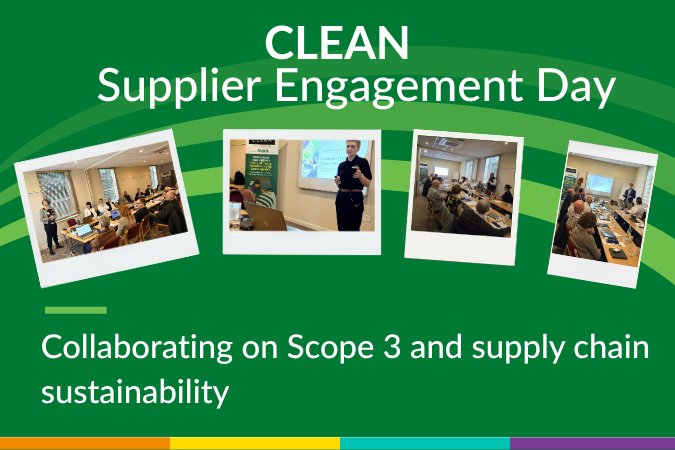
The aim was to align on our sustainability ambitions, build a shared understanding of where we stand, and agree on the steps that will make the biggest difference. Much of the discussion centred on Scope 3 emissions, the indirect emissions across our value chain, because this is where collaboration between suppliers and customers counts most, and where many customers’ own net-zero targets are directly affected.
Building on a shared baseline
The session opened with a review of our 2025 performance and progress on carbon reduction, giving everyone an honest picture of where we stand. This shared baseline matters: it is hard to set fair expectations or measure real progress if suppliers and customers work from different assumptions, and it gives customers greater confidence in the data we report.
Introducing the Suppliers Hub
One of the day’s most significant moments was the launch of the Suppliers Hub, a single online platform that makes working together simpler and more transparent. Rather than responding to scattered requests, partners can use a single place to report emissions, upload greenhouse gas reports, identify projects, and track Scope 3 reductions over time.
Good decisions depend on good information, and our supply chain data is not yet as complete or consistent as it could be. A central space for accurate, up-to-date figures moves everyone from broad estimates towards a reliable picture of where emissions sit, which matters increasingly to customers asked to evidence credible supply chain data in their own tenders and reports. The Hub also sets clear expectations and an onboarding timeline, so suppliers know what is being asked of them.
Setting clearer Scope 3 expectations together
Scope 3 emissions make up by far the largest share of our footprint. In 2025 they stood at around 28,400 tonnes of CO₂e, driven largely by textile production, purchased goods, outsourced transport and the end-of-life disposal of linen, so this is where the greatest opportunity lies and no single organisation can tackle it alone.
We shared a draft set of expectations for our strategic suppliers: providing a full Scope 1, 2 and 3 emissions report and completing reporting through the Greenly platform by the end of 2026, working towards EcoVadis accreditation by 2028, progressing life cycle assessments for the products they supply, and identifying at least three initiatives to reduce their carbon footprint. We were honest that we are not yet where we want to be, and the open discussion about roadblocks to data sharing was among the day’s most valuable. These requirements reflect what customers increasingly ask of us, and the data and accreditations are transferable, supporting suppliers’ wider businesses too. Encouragingly, several suppliers chose to enrol on Greenly and EcoVadis once the benefits became clear.
Working through the details in breakout sessions
Much of the day’s real value came from the breakout sessions, where suppliers worked through the practical details with us.
The first looked at Scope 3 hotspots, barriers and opportunities, with the weight and volume of products emerging as one of the most powerful levers available. Because transport emissions are broadly proportional to weight, reducing the mass of textiles or packaging cuts carbon and lowers fuel and freight costs, and lighter textiles need less energy to wash and dry.
The second explored joint-venture and co-investment opportunities, where shared projects and risk could unlock progress that is harder to achieve alone. The third focused on recycling and circularity, covering the barriers to using more recycled content, such as cost, quality and availability, and opportunities to reuse assets like pallets and intermediate bulk containers. A consistent message emerged: the obstacles are rarely a lack of good ideas, but the cost of change, the limits of current data, and plain inertia.
Collaboration in action: two case studies
Kate Karlinska-Peshawaria shared two partnerships already producing real results, both built on the belief that the biggest opportunities are found not in reports but in conversations and site visits.
By combining the supplier’s packaging expertise with our knowledge of the operation, we surfaced three opportunities: shrink wrap, reject bags, and cage covers. A shrink wrap trial at two sites, attended in person by Emma from Stevenage Packaging and Kate, reduced roll width from 750mm to 700mm and thickness from 12 to 11 microns with no impact on packaging integrity, cutting plastic, carbon and cost.
The second reversed the perspective: CLEAN helped a customer, Frasers Hospitality, cut transport emissions by improving delivery efficiency rather than reducing service. Analysis of routes, schedules and vehicle use was paired with hotel visits and on-the-ground conversations, identifying potential annual savings of around 29,000 miles and 30 tonnes of CO₂, now being trialled. As Kate put it, the numbers matter, but it was the relationship that made the opportunity possible.
The priorities we identified together
Drawing the sessions together, clear shared priorities emerged, with the most effective actions often delivering both carbon and financial savings. Transport and logistics optimisation ranked highly through better route planning, delivery consolidation, and the move towards lower-carbon fleets. Product weight and lightweighting surfaced repeatedly as one of our most powerful levers, cutting emissions and cost at almost every stage. Packaging reduction, greater use of recycled content and circular solutions such as reusing pallets and intermediate bulk containers followed. Underpinning all of it were two enablers: better data, systems and supplier reporting, and collaboration across the whole value chain.
A team effort
A day like this does not come together on its own. Our thanks go to the CLEAN team, Chris Bell, Kate Karlinska-Peshawaria, Andre Delport, Robert Morris, Aliya Akhtar, Mark Durose and Adrian Neale, for their preparation and hard work, and to the suppliers who gave their time and contributed so openly:
Tibard — Ian Mitchell
Stevenage Packaging — Emma Amondson
Christeyns — Peter Wallace, Dan Bircham and Jonathan Hammond
Vision Linens — Rachael Garner and John Kelsall
Richard Haworth — Lyndsey Oakes, Ian Yates and Shaun Colderley
NRG Riverside — Jenny Cook
Suez — Cory Slocombe
We were also grateful for wider perspectives from Rachael Garner of Vision Linens on aligning suppliers and customers around shared goals, and from Andrew Glassford of the The Textile Services Association (TSA) on why genuine supplier partnerships matter to the future of our industry. Above all, the day belonged to our suppliers, whose openness and practical thinking made it productive.
What happens next
We left with a clear sense of focus: consolidating the many ideas from the breakout sessions into a manageable set of initiatives; developing a draft Scope 3 supplier framework that fairly sets out our expectations, including reporting through Greenly, progress towards EcoVadis accreditation and ongoing life cycle assessments; and progressing the most promising joint opportunities, building on the results with Stevenage Packaging and Frasers Hospitality. We will also continue rolling out the Suppliers Hub, prioritising steady progress over overpromising.
Key takeaways and way forward
Our second Suppliers Engagement Day reinforced a long-held belief: real progress on sustainability comes from working together, openly and consistently, and the relationship often matters as much as the result. For customers, the work we do across our supply chain is ultimately in service of your goals, and we see our role as a dependable partner who makes that journey easier.
If you would like to know more about CLEAN’s approach to sustainability, or if you are a supplier who shares our commitment to doing things better, we would welcome a conversation. Sustainable progress is a team effort, and we are always glad to welcome more people to the team.
Share this page:
ShareNews Categories
For all media and PR enquiries please contact our Marketing Department.
Email: Email Us
Telephone: 0330 818 7027