Contamination risks hiding in plain sight in food production workwear
Posted on Jul 31, 2026
Most contamination risks on a food site are the ones you have already designed out. The controls are written up, the zones are colour coded, the swabs come back clean. The risks worth a second look are the quiet ones that sit inside routines everyone trusts. Workwear is often one of them, because a coat that looks clean and a coat that is hygienically clean are not always the same thing.
With BRCGS audits to prepare for and Christmas production about to push everything harder, this is a good moment to walk the garment journey as you would a HACCP flow and ask where a hazard could slip through.
When garments cross the line between zones
Zoning only works if everything that moves between areas is controlled, and workwear moves constantly. A team member steps out of a high-care area for a break, walks through a lower-risk corridor, and comes back. A maintenance engineer crosses from a raw-handling area into a high-care line to repair a machine. Agency staff brought in for the seasonal peak may not be as familiar with your colour coding as your permanent team.
Each of those movements is a chance for a garment to carry something across a boundary you have worked hard to hold. Allergens are the version of this that catches people out, because there is nothing to see. A coat worn near a line handling nuts or milk can pick up traces and carry them into an area meant to be free of them. For a producer making allergen-free products, that is the difference between a safe batch and a recall.
None of this means your zoning is wrong. Garments are simply one of the few things that legitimately need to move between zones, so they deserve the same scrutiny as any other cross-zone control.
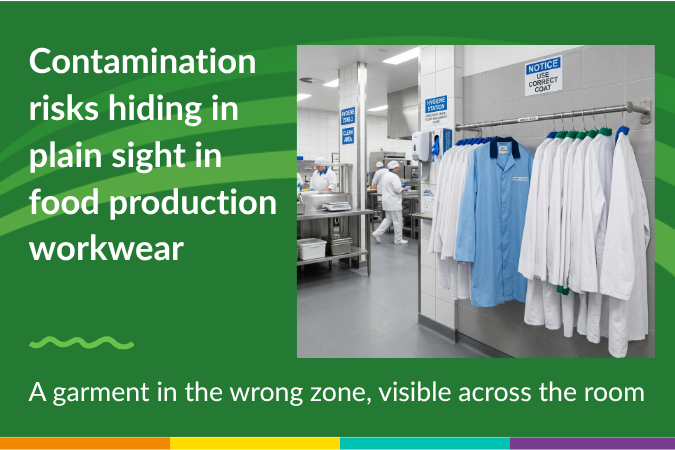
There is a simple way to catch those crossings. Our range of food garments can be colour-coded to the zones in your unit, either with different-colour collars on white coats or with different-colour food coats, so a garment in the wrong area is visible straight away. It turns a hidden risk into something a supervisor can spot across the room.
The home-washing gap
Home washing is one of the most common weak points, and it usually starts for sensible reasons. Someone takes a spare coat home to help out during a busy week. A new starter is waiting for their full issue of garments. It feels harmless, and the coat comes back looking spotless.
The problem is that you lose control and evidence at the same moment the garment leaves the site. A domestic machine at 30 or 40 degrees does not reach the temperatures required for thermal disinfection, and it will not reliably remove allergens. The same drum may have washed the family's clothes an hour earlier. There is no record of what temperature was used, no separation of clean from dirty, and nothing you can show an auditor.
When a BRCGS auditor asks how you know your workwear is hygienically clean, "the team take it home" is a difficult answer to defend. A managed workwear laundry service provides wash validation, temperature records, and traceability that turn a reasonable assumption into documented evidence.
The bit between the wash and the wearer
Even when garments are laundered properly, the journey from clean to worn is easy to overlook. Freshly laundered coats left hanging in an open corridor, stored next to used garments, or handed out from a shared pile can pick up contamination before they are ever put on. Transport and storage are part of the flow, so they carry the same hazards as any other step.
This is where the practical details matter. Clean garments need to stay separated from dirty ones from the moment they leave the wash, through transport, to the point they reach the wearer. Barrier plant segregation keeps dirty and clean garments physically apart during laundering, and a controlled distribution method, such as a locker valet service, keeps that separation intact all the way to each named employee. It also means the right person gets the right garment, in the right size, every time, which matters more than usual when you are onboarding temporary staff at speed.
Reading it as a HACCP flow
If you map workwear the way you map a product, the control points appear on their own. Where do garments cross from one zone to another? Where could an allergen be carried across? Where is the wash temperature actually verified, and where is that record kept? Who handles clean garments, and are they kept apart from used ones until they reach the wearer? Most food and quality managers already think this way about ingredients and process; the same lens applied to workwear tends to surface one or two gaps worth closing before an auditor finds them.
How CLEAN supports the hygiene standard you have to meet
This is the work CLEAN does for food producers and caterers every day. Our food production workwear and food service uniforms are rented and laundered as a managed service. Garments are thermally disinfected, laundered through allergen-tested processes, and kept apart through barrier plant segregation so that clean and dirty never mix. Every item is barcoded and scanned at four points throughout the laundry, providing traceability and change records you can present to an auditor. The locker valet service delivers the right garment to the right person while maintaining that clean separation through the last step.
Just Love Food Company is a good example. They make allergen-free celebration cakes for major supermarkets, so allergen control is central to everything they do. CLEAN supplies them with fresh, BRC Global Standard-compliant uniforms through a locker valet service and continues to adapt as they develop new products and remove further allergens from their ranges. You can read the full story in the Just Love Food Company case study.
Workwear rarely makes the top of the risk register, which is exactly why it is worth a look before your next audit and before the seasonal peak stretches everything.
If you would like a second pair of eyes on your hygiene barriers, we can run a short, free workwear hygiene review and show how our workwear rental service can help strengthen your hygiene controls. Call 0330 818 7008 or visit cleanservices.co.uk/contact to arrange one.
Share this page:
ShareNews Categories
For all media and PR enquiries please contact our Marketing Department.
Email: Email Us
Telephone: 0330 818 7027