How a workwear locker valet service cuts shift changeover time
Posted on Oct 20, 2026
It is 05:52 on a Tuesday. Fourteen people are due on the line at six, and most of them are still in the changing room, still in their own clothes.
The clean garments came back yesterday in hamper bags, and the bags are still standing by the door. One worker has a jacket up to the light, hunting for a size label that has washed out. Two others are on their third coat. Another has taken a large because the mediums went first, and he will spend eight hours with the cuffs over his hands. In the corner, the supervisor is working out who can be moved where, because two flame-retardant coveralls that should be on site are in a bag somewhere between here and the laundry.
It starts for sensible reasons. Garments arrive in bulk; the bags are put down wherever there is room, and they are sorted by whoever reaches them first.
The hidden cost of searching for workwear
Count it properly, and the changing room becomes one of the more expensive rooms on site. For example, if each person loses ten minutes hunting for workwear, fourteen people on a shift lose 140 minutes between them. Over three shifts a day, that's around seven hours of paid time every day that produces nothing. Across a five-day week, it comes to roughly 35 hours, almost a full-time employee's working week, spent looking for workwear.
Then there are the costs that never reach a timesheet.
Hi-vis and flame-retardant garments are certified on the assumption that they fit the wearer. A coverall two sizes too big is a snag risk near moving parts, and it has stopped doing the job it was bought for. Anyone who has watched someone roll cuffs back before starting a shift knows the compliance folder and the shop floor have quietly parted company.
Workwear also goes missing. When garments belong to everybody, they belong to nobody, and a steady trickle goes home in cars and never comes back. Replacement costs are absorbed as a fact of life.
Audits expose the gap too. A customer or inspector may ask which garments a named operator was issued and when they were last cleaned to the required standard. A hamper bag by the door can't tell them.
The same shift starts with a workwear locker valet system
05:52 again. Same fourteen people, same shift.
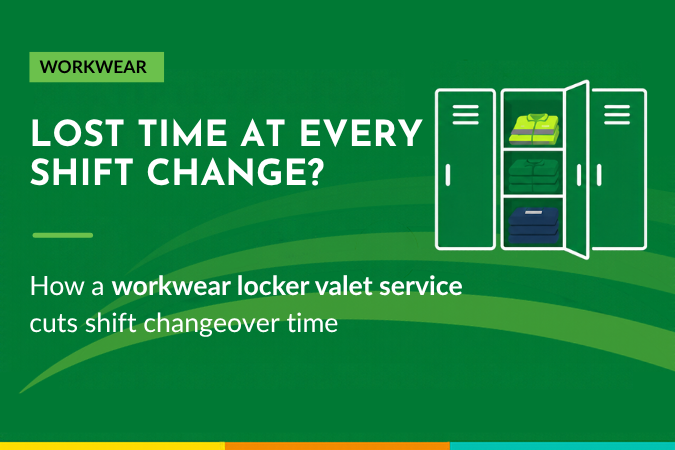
Each one walks to a uniform locker bay and opens their own compartment. Their name on the door, their sizes inside, the right spec for the area they work in. Yesterday's dirty garments went into a sealed compartment in the same bay on the way out.
By 05:58, there are people on the floor. The supervisor is not in the changing room at all.
That is the whole difference. It isn't exciting, and that's exactly the point. The changeover stops being a daily problem to be managed and becomes a routine nobody has to think about.
How a managed workwear service works
Four things, none of them dramatic.
Garments are issued to a person, not a pile. Everyone is sized properly at the start, and their allocation stays theirs. No hunting, no size lottery, no wearing whatever is left in the bag.
Every garment is tracked. Barcode scanning logs each item when it leaves the site and again when it returns. You can see what is in circulation, what is in the wash and what is due back this week. When an auditor asks, there is a record rather than a recollection.
Delivery goes into the locker. With a locker valet service, clean garments are placed directly into each person's compartment, and used items are collected from the same place on the same visit. Nothing is left by the door for people to sort through.
Deliveries run to a schedule. Fixed days and times, agreed around your shift pattern, with a stock buffer sized to your headcount. Damaged workwear comes back repaired rather than being pulled out of use and quietly forgotten.
A workwear site review: Getting from one to the other
A site review is a walk around the changing room with someone who has set this up before. Roughly what gets looked at:
Headcount by role and shift pattern, including the contractors and agency staff who tend to get left off the list
Sizing, and how many garments each person genuinely needs between deliveries
Hazard specs by area: flame retardant, anti-static, chemical splash, hi-vis
Where the workwear lockers sit relative to the door and the line, because ten metres of walking in the wrong direction undoes most of the gain
Delivery day and time, and how much buffer stock it takes to absorb a bad week
Most sites come out of a review with two or three changes rather than a rebuild. Locker position and delivery timing usually do more work than anything else on the list.
A small change that solves bigger problems
The changing room may be out of sight, but its impact can be seen throughout your operation. It affects start times, productivity, supervisor workload, and even garment control. When the process isn't working, the same issues surface shift after shift.
If changeovers are causing disruption on your site, book a site review. We'll help you streamline the process, reduce delays, and improve garment accountability. Call 0330 818 7008 or visit https://www.cleanservices.co.uk/workwear
Share this page:
ShareNews Categories
For all media and PR enquiries please contact our Marketing Department.
Email: Email Us
Telephone: 0330 818 7027