How many production hours are you losing to managing workwear on site every week?
Posted on Jul 27, 2026
Monday, 7.40 am. Two new starters need kitting out, and nobody can find medium coveralls. A team leader wants to swap a jacket with a broken zip. Someone on nights has reported his locker empty again. By the time the line starts, the shift supervisor has spent forty minutes on clothing, and it is only Monday.
Nobody puts workwear admin on a spreadsheet, which is why it survives. The time it takes is real; it lands on your most experienced people, and on many sites, it adds up to a working day every week.
The hidden cost of workwear
Break the week down, and the list is longer than it feels. Issuing garments to starters and recovering them from leavers. Chasing items that went home and stayed there. Size swaps. Complaints about condition, zips, missing buttons and shrunken sleeves. Working out whose overalls are whose after a mixed wash. Reordering and arguing with a supplier about a delivery. Each task is five or ten minutes. None of them makes anything.
Warning signs of the hidden cost
Some sites feel the drag without ever seeing it. The tells are consistent:
Supervisors keep a private stash of spare garments because the official route takes too long.
New starters spend their first days in ill-fitting or borrowed kit.
The same complaints about zips, sizing and missing items come up in every toolbox talk.
Nobody can say, today, how many garments the site owns or where they are.
If two or more of those sound familiar, the hours are going somewhere. The next step is counting them.
A worked example
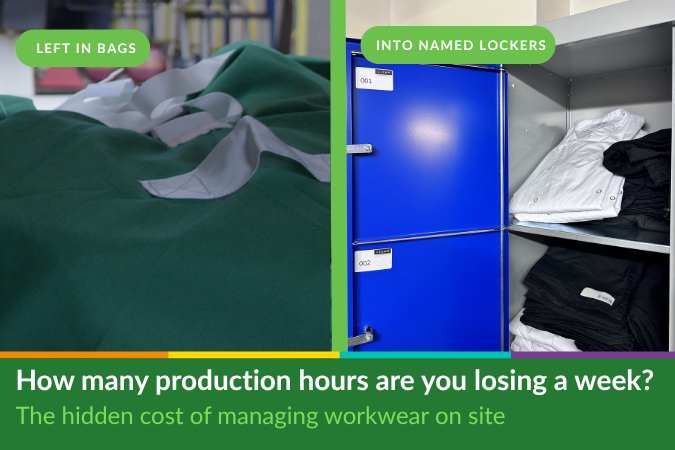
One organisation with around 100 wearers was experiencing ongoing delivery issues with their previous supplier. Instead of loading clean garments directly into employee lockers, deliveries were simply left in bags on the changing room floor.
The result?
Untidy and cluttered changing facilities.
Employees struggling to find their garments.
Increased reports of missing or misplaced items.
Supervisors spending valuable time sorting and redistributing clothing each week.
While leaving garments in bags may seem like a small shortcut, the operational impact is significant. For a workforce of 100 employees, even spending just one to two minutes per person locating or sorting garments adds up to three to five hours every week. Over the course of a year, that is more than 150 hours of lost productivity, equivalent to around 20 working days.
Those are hours that could be spent managing people, improving operations or serving customers, rather than searching through bags of workwear.
At CLEAN Workwear, garments are delivered directly to each employee’s allocated locker, wherever this service has been agreed. This ensures every wearer receives the correct garments, changing rooms remain tidy, and managers are freed from the unnecessary administration of sorting misplaced clothing.
Sometimes the biggest savings are not found in the rental price. They are found in eliminating the hidden costs that poor service creates.
Your numbers will differ. The point of the exercise is that almost nobody has done it for their own site, and the answer is rarely small.
To run it for your own operation, keep it rough and honest. Ask each supervisor to jot down clothing interruptions for one ordinary week, note the storeroom and office time against workwear tasks, and add it up on Friday. An hour of counting usually settles an argument that has run for years.
Why it lands on your best people
Workwear problems: find the person who can fix them; that is usually a supervisor or team leader. These are the people you rely on to keep the line moving and coach the team, and they end up refereeing arguments about trousers. Their time is expensive, and what they spend it on is even more expensive.
There is a knock-on cost too. When the supervisor is in the storeroom, the toolbox talk waits, the line check waits, and the near-miss conversation never quite happens. Workwear admin rarely appears on a risk register, yet the time it takes comes from exactly the activities that keep one clean.
What a managed service removes
A workwear rental and commercial laundry service like CLEAN's is built to take this category of work off your hands. Each wearer receives their own professional workwear through our workwear rental service, tracked by barcode at every wash.
Clean kit arrives on a scheduled delivery and goes into named lockers, so a shift starts with everyone finding their own size where they left it. Repairs happen at the laundry, spotted at quality check rather than reported through a supervisor. Size changes and starters are handled on the next round. The storeroom of mystery garments disappears, along with the launderette runs and the reorder spreadsheet.
Supervisors keep one job: telling us when something changes.
The reporting matters as much as the lockers. Because every garment is scanned through every wash, the site has a record of what each wearer holds, what has been repaired and what has been replaced. When an auditor or a customer asks how workwear is managed, the answer should be a report, not a shrug, which is a better use of everyone's afternoon.
Why now?
If your site runs a summer maintenance shutdown, this is the natural window. Quiet lines make it easy to survey wearers, agree sizes and fit lockers, and a new uniform rental service is bedded in before the autumn ramp-up rather than introduced in the middle of it. Sites that wait for a quieter moment in autumn tend to discover there is not one.
Book a short on-site survey to discover how our workwear rental and laundry service can help your site, and we will quantify the time your site could free up for production. Call 0330 818 7008 or visit cleanservices.co.uk/content
Share this page:
ShareNews Categories
For all media and PR enquiries please contact our Marketing Department.
Email: Email Us
Telephone: 0330 818 7027