What do the EN standards on workwear labels actually mean?
Posted on Jul 28, 2026
EN standards are the European safety standards against which protective workwear is tested and certified. The pictograms on a garment's label indicate which hazards it protects against, and the numbers and letters alongside them indicate the level of protection it provides. Read together, they tell you exactly what a garment is certified to do.
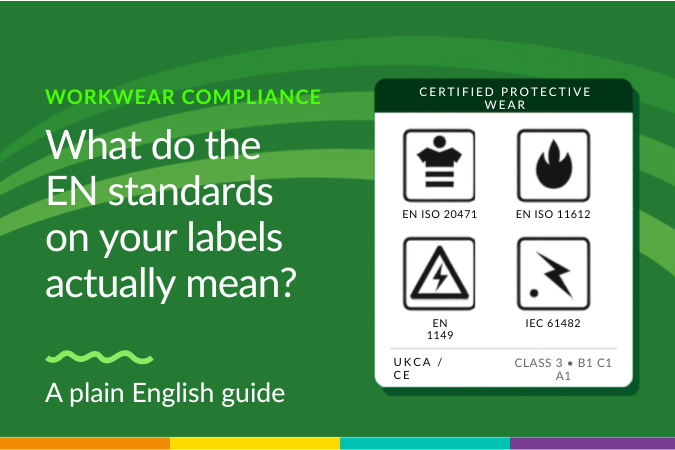
That is the short answer. The longer one is worth five minutes of any H&S manager's time, because the label inside a garment is the first place anyone looks for what it protects against. If you are specifying protective clothing, auditing it, or defending a decision after an incident, the label is where the conversation starts.
The label is a certificate in miniature
Every piece of certified protective workwear carries a CE or UKCA mark, indicating compliance with the PPE Regulation, plus one pictogram for each standard it is certified to. Next to or beneath each pictogram sit numbers and letters that record the performance level achieved in testing.
One garment can carry several standards at once. A jacket for an electrical engineer might feature hi-vis, flame, anti-static, and electric arc pictograms. Two-piece clothing is usually certified as a set, so the jacket and trousers must be worn together to provide the stated protection.
The label symbols and pictograms you will see most often
EN ISO 20471, high visibility. The standard for high visibility clothing: a vest symbol with a number from 1 to 3. The class reflects how much fluorescent background material and reflective tape the garment carries, and Class 3 is the highest. Only yellow, orange and red are approved colours. EN ISO 20471 replaced the older EN 471, which you may still see on ageing stock. Rail work has its own requirement, RIS-3279-TOM, which specifies orange.
EN ISO 11612, heat and flame. A flame symbol with code letters. A covers limited flame spread, B convective heat, C radiant heat, D molten aluminium splash, E molten iron splash and F contact heat. The number after each letter indicates the performance level; B1 and B3 protect against the same hazard to different degrees. This is the standard most flame-retardant workwear, also called flame-resistant or FR clothing, is certified to.
EN ISO 14116, limited flame spread. A lighter-duty flame standard for garments that resist ignition and limit flame spread, but do not carry the full heat protection of EN ISO 11612.
EN ISO 11611, welding. Protection against spatter and the heat of welding and allied processes, in Class 1 or the higher Class 2.
EN 1149, anti-static. Garments that dissipate static charge, essential anywhere a spark could ignite vapours, gases or dust.
EN 13034 (Type 6) chemical splash protection. Designed to protect against light chemical splashes and sprays. It provides short-term protection, giving the wearer time to remove the garment, but is not suitable for pressurised sprays or prolonged exposure to chemicals.
IEC 61482, electric arc. Protection against the thermal effects of an electric arc, often called arc flash, tested by class or by an arc rating figure.
If a hazard on your risk assessment has no matching pictogram on the label, the garment is not certified for that hazard, even if it feels heavy or well-made.
Certified on day one is only half the job
A certification mark is not a lifetime guarantee. It confirms that a garment met a required performance standard when tested, but those standards can only be maintained if the garment itself is properly cared for.
Protection can fade long before the label does. High-visibility garments provide a clear example: UV exposure, dirt and repeated washing gradually reduce the effectiveness of fluorescent fabrics. Over time, a jacket certified as Class 3 may no longer offer Class 3 levels of visibility.
Other types of PPE are equally vulnerable. Improper laundering can strip away flame-retardant finishes, while fabric softeners can interfere with their performance. Even well-intentioned repairs can create weak points. Replacing damaged sections of a flame-retardant garment with ordinary fabric or thread may leave those areas unprotected.
For that reason, the care label deserves the same attention as the certification symbols. Maintaining PPE is not optional; it is a critical part of ensuring that protection remains effective. A garment that no longer meets the standard it was certified to achieve may still look compliant on paper, but it cannot be relied upon in practice.
Where a managed laundry service fits
Keeping protective properties intact through hundreds of wash and wear cycles is a specification job. At CLEAN, garments in our workwear rental and laundry service are washed to processes matched to the fabric and its finishes, inspected on every cycle, repaired with compliant materials, and replaced when protection can no longer be restored. Our full range and the standards behind each garment type are set out in our EN standards guide.
Frequently Asked Questions
What does the number under the hi-vis symbol mean?
The garment's class under EN ISO 20471 is from 1 to 3. Higher classes carry more fluorescent material and reflective tape, and Class 3 is generally specified for the highest-risk settings, such as high-speed road work.
Can flame-retardant workwear be washed at home?
It is risky. Domestic washing cannot guarantee the finish will survive, and fabric softener can build up on flame-retardant fibres, impairing protection. Professional laundering follows the manufacturer's process, so certification is maintained. Our guide to home washing versus professional laundering covers this in detail.
Do EN standards still apply in the UK?
Yes. They are published as BS EN standards in the UK, and workwear is certified under the PPE Regulation with CE or UKCA marking.
What if the label has worn away?
Treat the garment as uncertified until you can confirm its identity. An unreadable label is a common audit finding, and one that a rental service prevents, because garments are tracked and replaced before labels fail.
Not sure what you are looking at?
Send us a photo of the label, and we will explain exactly what your garments are certified for, and whether that matches the work your team does. Call 0330 818 7008 or visit https://www.cleanservices.co.uk/contact.
Share this page:
ShareNews Categories
For all media and PR enquiries please contact our Marketing Department.
Email: Email Us
Telephone: 0330 818 7027