What it takes to get carcinogens out of firefighters’ PPE
Posted on Nov 19, 2026
When a firefighter leaves an incident, the contamination on their PPE stays with them.
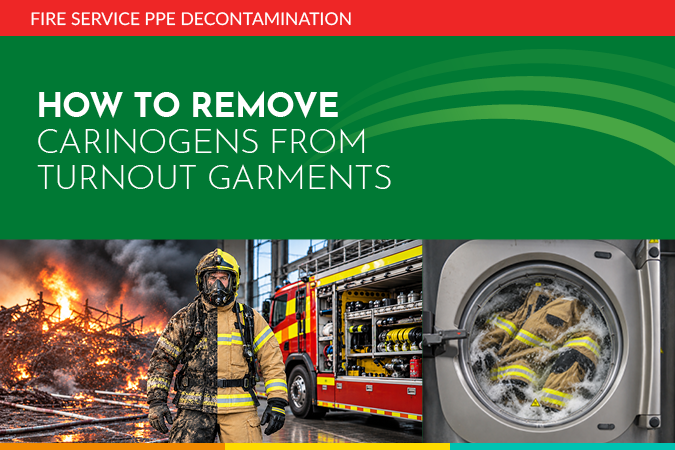
The real danger comes from polycyclic aromatic hydrocarbons (PAHs), chemicals produced during combustion. Small enough to be absorbed through the skin or inhaled, they settle deep into turnout gear, gloves and breathing apparatus, and remain a risk every time those items are handled or worn.
The stakes are high. The International Agency for Research on Cancer (IARC), part of the World Health Organisation, classifies occupational exposure as a firefighter as carcinogenic to humans. A 2023 University of Central Lancashire study of Scottish firefighters, cited by the Fire Brigades Union, found that their mortality rate from all cancers is 60% higher than that of the general population. Yet a 2023 UK study found that only about one-third of firefighters clean their PPE after every incident.
At CLEAN's specialist Banbury facility, we provide a decontamination process built around evidence-based detergents, a rigorous 15-point inspection and expert repairs to help ensure firefighting PPE returns clean, compliant and ready for duty.
Why Soot Is So Difficult to Remove
Firefighting contamination is very different from everyday workwear soiling. For turnout garments, decontamination must address all layers down to the breathable membrane without compromising the garment’s protective performance.
PAHs are also oil and fat-soluble, so they dissolve more readily as temperatures rise. Washing at low temperatures removes only part of the contamination.
Five Factors That Determine Effective Decontamination
Effective decontamination depends on five elements working together:
- Detergent quality and dosage
- Mechanical action
- Water temperature
- Wash duration
- Effective rinsing
These factors are closely linked. A stronger detergent may allow a shorter or cooler wash, while a longer cycle allows milder chemistry. The aim is the highest possible level of decontamination without compromising the garment's protective performance.
Temperature matters, but it is only one of the five factors. Lejon Kemi's documents report that conventional detergents and programmes at 40°C remove, on average, around 30% to 45% of the PAHs measured. With Lejon Kemi's optimised detergent and 60°C programme, independent tests have recorded 85% to over 93%, around double.
The Chemistry Behind the Clean
At Banbury, we use Lejon Kemi detergents, supplied in the UK through Scandecon by Vimpex. Lejon Kemi began a dedicated research programme in 2011 to develop detergents and wash programmes for firefighting clothing and equipment, and its products are now used by several hundred fire and rescue services.
Accredited laboratories in Sweden and Germany have tested them independently, using gas chromatography and mass spectrometry to measure the removal of 16 different PAHs. The tests used equipment contaminated with smoke and soot from real fires, rather than artificial chemical contamination, and full-scale washing machines at fire stations.
Independent Test Results
Turnout garments
- At least an 86.7% reduction in total PAHs
- At least an 87.9% reduction in carcinogenic PAHs
Washable gloves
- At least an 88% reduction in total PAHs (outer layer)
- At least an 80.3% reduction in carcinogenic PAHs
Results are based on Lejon Kemi detergents and wash programmes under specified washing conditions. CLEAN's laundry service covers turnout garments.
Different items need different chemistry. LTW Wash is the detergent we use to clean turnout garments, hoods and gloves only.
Correct dosage matters as much as the detergent. Water hardness and contamination levels both affect performance, so automated dosing keeps results consistent, load after load.
How This Evidence Compares with NFPA Testing
In the United States, NFPA 1851, now consolidated into NFPA 1850, requires organisations offering advanced cleaning to pass a cleaning verification test. It is a useful, standardised check, but it has clear limits:
- It uses clean fabric swatches spiked with known amounts of selected chemicals, which do not behave like the carbon-bound, tar-like soot left by real fires.
- It tests material samples rather than complete garments, and the 2020 edition does not apply it to hoods, gloves, helmets or footwear.
- It sets a pass mark of 50% average removal across the selected contaminants, rather than reporting the carcinogens separately.
- NFPA 1851 limited advanced cleaning to 40°C. NFPA 1850 now allows up to 60°C for specialised cleaning; Lejon Kemi’s 60°C programmes have been in routine use at fire services since 2018.
The Lejon Kemi evidence goes further. Complete items, including turnout suits sampled through every layer down to the membrane, both layers of gloves, breathing apparatus sets and masks, were contaminated with smoke and soot from real fires and washed in full-scale machines at fire stations. Independent accredited laboratories measured all 16 EPA-listed PAHs individually by GC-MS, reporting the seven carcinogenic PAHs separately. Each result is tied to a defined detergent, dose, temperature, time and rinse, so the process can be repeated.
The two methods measure contamination in different ways, so the percentages are not a like-for-like score. What the Lejon Kemi results show is performance on real fire contamination, across whole items, under conditions a fire service or laundry can reproduce.
Washing Is Only Half the Process
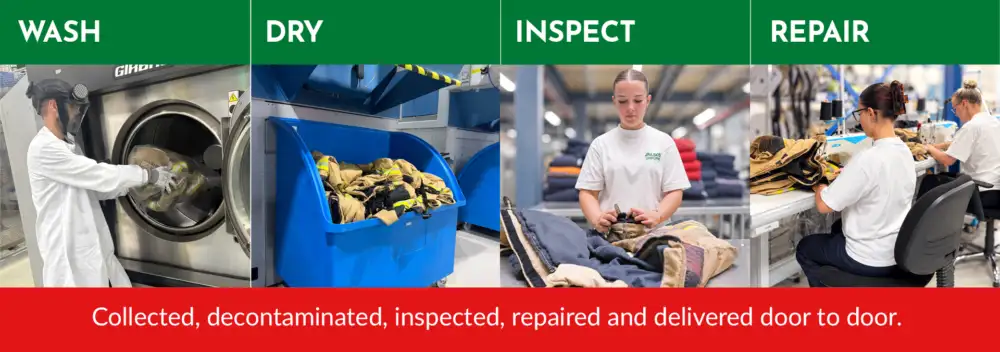
Contaminated garments are sealed in soluble bags before collection, which limits handling and cross-contamination, and then dissolve in the wash. Every item is barcode-tracked, creating a complete garment history and audit trail.
After decontamination, certified technicians inspect every garment against our 15-point check, following manufacturer protocols:
- Dirt and soiling
- Contamination
- Moisture barrier integrity
- Rips, tears and burns
- Reflective trim
- Seams
- Liner integrity and discolouration
- Wristlets
- Retroreflection
- Liner attachment
- Fixtures
- Closures, including zips, Velcro and studs
- Braces
- Labels and barcodes
- Water droplet testing
Any fire suits or gloves that do not meet the required standard are rewashed, repaired or removed from service.
Repairs use original or manufacturer-approved materials and are carried out by technicians trained by the garment manufacturers. Every repair is recorded against the garment's barcode and reinspected before it goes back into service.
Why Fire Services Choose CLEAN's Fire Service Cleaning and Maintenance Process
In partnership with Vimpex, we use Lejon Kemi detergents, which, in independent tests on turnout garments, removed at least 86.7% of the 16 PAHs measured and at least 87.9% of the carcinogenic PAHs.
Garments come back on a seven-day turnaround, with optional reserve stock so crews always have safe, compliant PPE to hand.
Firefighters should not have to question whether carcinogens have been removed from their PPE. They need to know that every garment returned to service is clean, inspected and fit for purpose.
That's the responsibility of the people who launder it.
Reviewing Your PPE Decontamination Process?
Your firefighters rely on their turnout gear to protect them in the most demanding environments. If you're reviewing how your service cleans, inspects and repairs turnout garments, our specialist team is here to help. Call 0330 818 7008 or learn more about our Fire Service Cleaning & Maintenance Process.
Share this page:
ShareNews Categories
For all media and PR enquiries please contact our Marketing Department.
Email: Email Us
Telephone: 0330 818 7027